

Article: Light at Night: Simple Evening Changes for Better Sleep
Light at Night: Simple Evening Changes for Better Sleep
- Light at night is any bright or stimulating light exposure in the evening that can keep your brain in “day mode.”
- You do not need a perfect nighttime routine to make evenings feel calmer.
- A few small shifts, like dimmer lamps, softer screens, and one reliable wind-down cue, may help your body recognize that the day is ending.
- Consistency beats intensity. One simple habit done often is usually more useful than a complicated plan done once.
- Not every tip fits everyone. The goal is to make evenings feel a little gentler, not perfect.
Some evenings feel loud before they even feel late.
You finish work, answer one more message, open one more tab, tidy one more thing, and suddenly your brain still feels switched on even though your body is tired. That does not mean you are doing evenings “wrong.” It often means your environment is still sending signals that the day is active.
Light is one of those signals.
The good news is that you usually do not need to overhaul your entire routine. A few small changes in how light shows up around you at night can make evenings feel softer, calmer, and easier to wind down from.
Why light at night can make evenings feel more alert
Light at night and sleep is a simple idea: when your environment stays bright late into the evening, your brain may stay more alert too.
Evening light means the light exposure you get in the hours before bed, from overhead lighting, lamps, screens, TVs, kitchen lights, bathroom mirrors, or even bright hallway lighting.
A wind-down cue is a consistent signal that tells your body the active part of the day is ending. It can be light, scent, sound, or a small repeated action.
For some people, bright light at night can make it harder to shift into a calmer state. It is not only about screens. Overhead lighting, late-night chores under bright bulbs, and moving between fully lit rooms can all keep evenings feeling more “go” than “slow.”
This is not about fear or perfection. It is about noticing that your nervous system responds to the atmosphere around you. When the atmosphere stays sharp, bright, and busy, winding down may feel less natural.
What “light at night” actually means
When people hear “light at night,” they often think only about phones.
But in real life, it usually looks more like this:
- Ceiling lights that are much brighter than you need
- Kitchen or bathroom lights late in the evening
- Laptop work in a dark room with a bright screen
- TV plus scrolling plus overhead lighting at the same time
- Turning every room fully on right before bed
The goal is not to sit in darkness. The goal is to make the last part of the evening feel visually quieter.
A calmer visual environment can be a helpful cue. It may support the transition from activity to rest, especially when paired with other simple habits.
5 small ways to soften evening light
1) Start with one lamp, not the whole room
A simple place to begin is to stop defaulting to full overhead lighting once the evening starts.
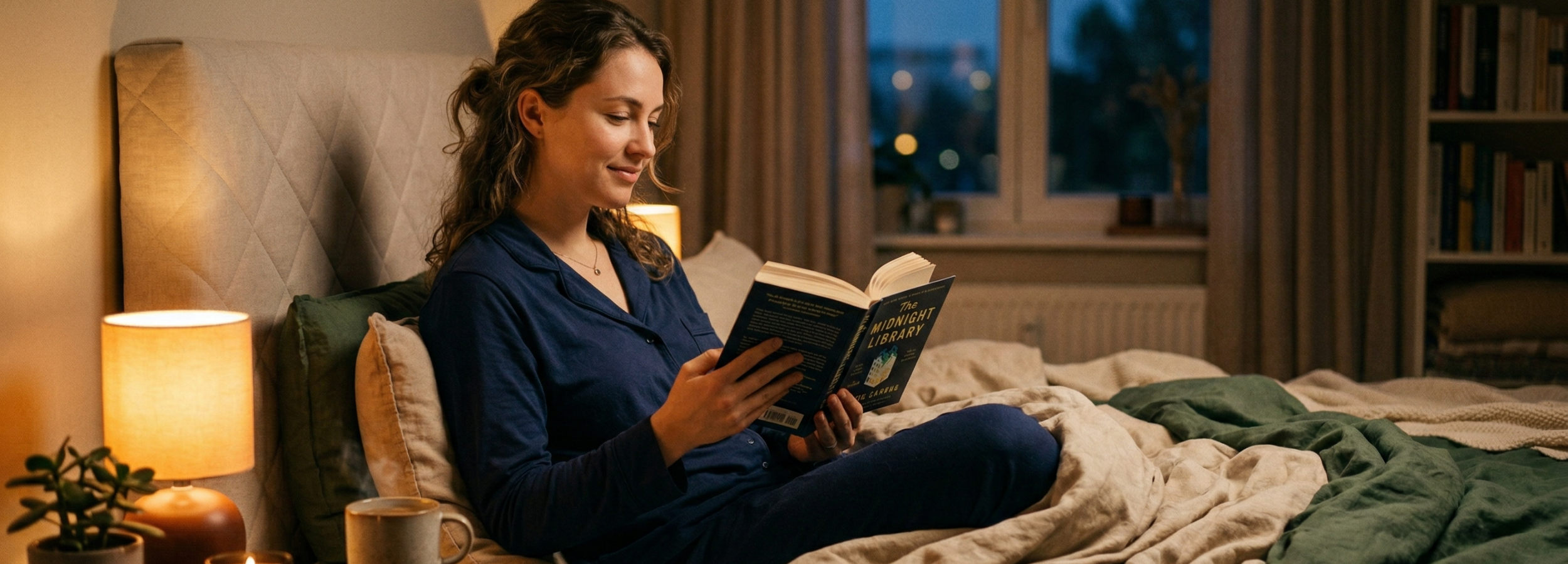
Instead, try using one softer light source in the room you spend the most time in. A lamp, wall light, or warm bedside light often feels calmer than a bright ceiling light.
This works because overhead lighting tends to make a space feel active and alert. Lower, softer lighting can make the room feel more settled.
You do not need to do this all night. Even choosing softer light for the last hour of your evening can make a difference in how that time feels.
2) Move bright tasks earlier
Some evening activities need more light. Folding laundry. Packing a bag. Cleaning the kitchen. Answering a few last emails.
Rather than trying to eliminate those tasks, try shifting them a little earlier when possible. That way, the final stretch before bed is less bright and less task-heavy.
This is useful because the issue is often not one single light source. It is the combination of brightness plus “still doing things.”
A calmer evening usually comes from reducing stimulation in layers.
3) Make screens a little gentler
You do not need a dramatic digital detox to make progress.
A more realistic starting point is to make your screens slightly less intense:
- lower brightness
- use warmer display settings in the evening
- avoid holding screens very close to your face in a dark room
- choose one screen at a time instead of stacking phone + TV + laptop together
This is one of the easiest ways to reduce light at night without redesigning your life.
For some people, the bigger benefit is not only the light itself. It is the shift in pace. A softer screen often encourages softer engagement too.
4) Create one “dim-down” cue
A dim-down cue is a small action you repeat most nights that marks the transition out of active mode.
It could be:
- turn off the overhead lights
- switch on one warm lamp
- put your phone on a lower brightness setting
- start a calming audio track
- make a cup of herbal tea
This kind of cue matters because repeated actions become familiar. Familiarity can feel calming.
If it fits naturally into your routine, some people also like pairing lower light with another sensory cue, such as a comfortable sleep mask, a calming scent, or quiet audio. The point is not to add more steps. The point is to make the transition recognizable.
5) Keep your routine flexible, not perfect
This is the part many people need to hear:
A supportive evening routine does not have to be strict to be effective.
You do not need to dim every room at the same minute every night. You do not need to stop all screens forever. You do not need a flawless checklist.
You just need a few repeatable signals.
A flexible routine is often more sustainable than an ideal routine. It is easier to return to, easier to keep, and less likely to create pressure.
And pressure is rarely calming.
Not every tip fits everyone, and that is okay. The most useful evening routine is the one that feels realistic in your actual life.
Try tonight: a 60-second dim-down reset
Here is a quick micro-practice you can try tonight:
The 60-second dim-down reset
- Turn off the brightest light in the room.
- Lower your screen brightness by one step.
- Take one slow breath in.
- Exhale longer than you inhaled.
- Ask yourself: “What would make the next 20 minutes feel quieter?”
That is enough.
This is not about forcing sleep. It is about changing the tone of the evening.
Consistency matters more than intensity
A lot of people look for the perfect nighttime routine and end up doing nothing because it feels too complicated.
But with evening light, consistency matters more than intensity.
Using one lamp instead of overhead lights most nights is more helpful than building an elaborate wind-down plan you only follow once a week.
Lowering your screen brightness regularly matters more than buying new devices you never use.
Small cues repeated often can be powerful because they are easy to keep.
That is what makes them useful.
Key takeaways
- Bright evenings can keep the body and mind in a more alert mode.
- Light at night is not only about phones. Overhead lights, bright rooms, and task-heavy evenings all count.
- You do not need a perfect routine. Small shifts in light can make evenings feel calmer.
- Start with simple changes: softer lamps, gentler screens, and one repeated dim-down cue.
- Aim for repeatable, low-effort habits. Calm usually grows from consistency, not intensity.
FAQ
Does light at night really affect how calm I feel before bed?
It can. For some people, a bright environment in the evening may make it harder to feel settled. Softer light can be a helpful cue that the day is slowing down.
Is screen light the only problem?
No. Screens are one source, but overhead lights, bathroom mirrors, kitchen lights, and other bright evening lighting can also keep the environment feeling more active.
Do I need to avoid screens completely at night?
No. A full cutoff is not realistic for everyone. Lower brightness, warmer settings, and using fewer devices at once can be a more sustainable starting point.
What is the best evening light setup?
The best setup is the one you will actually use. For many people, that means fewer overhead lights and one or two softer light sources in the final part of the evening.
What if my evenings are inconsistent?
That is normal. A flexible routine still counts. Even one small cue, repeated often, can support a calmer transition into the night.
Can a sleep mask or scent be part of a wind-down cue?
Yes, for some people. A comfortable ergonomic sleep mask or a familiar aromatherapy cue can be part of a repeated bedtime ritual. The key is to keep it simple and consistent, not to rely on any one tool to do everything.
Blocking light completely during sleep is one of the most direct ways to protect your melatonin rhythm. Shallii's ergonomic blackout mask creates a total seal against ambient light — without pressing on your eyes — so your body can stay in rest mode through the night.

Leave a comment
This site is protected by hCaptcha and the hCaptcha Privacy Policy and Terms of Service apply.