

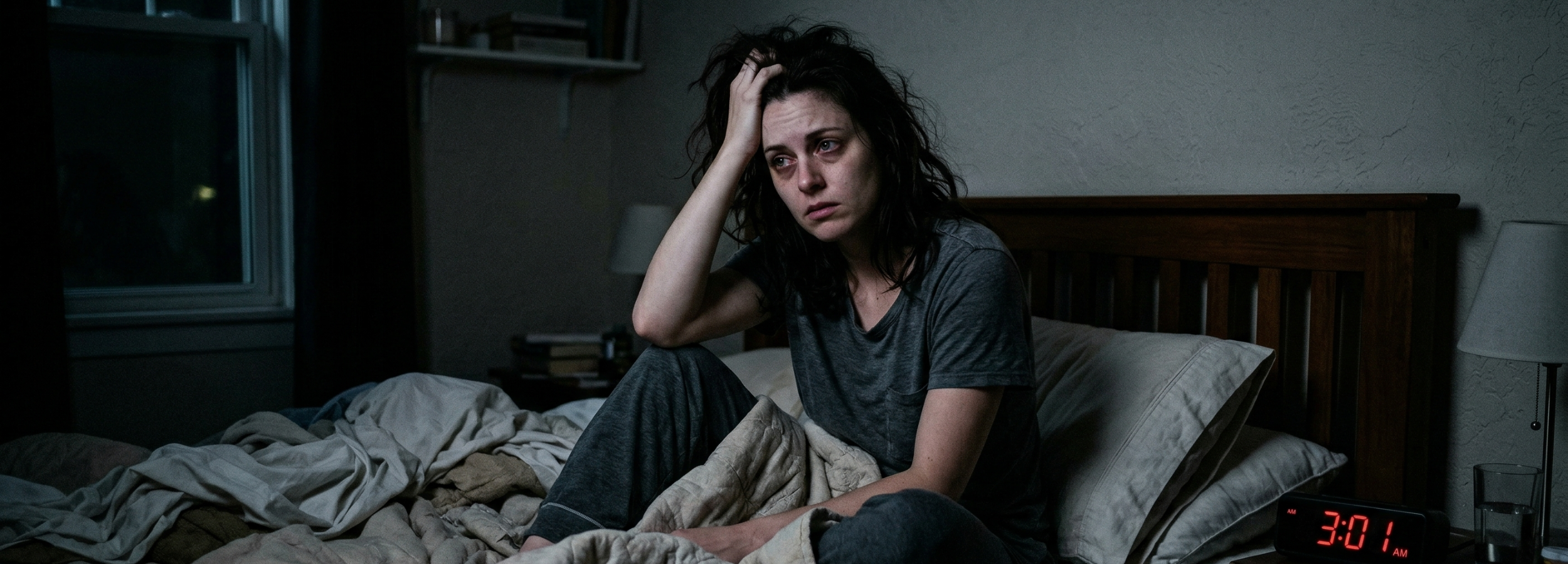
Awake at 3am? What Helps You Settle Again
- Waking in the middle of the night is common, even if it feels unsettling.
- The fastest way to make a 3am wake-up feel harder is to start monitoring, fixing, or forcing sleep.
- A calmer goal often helps more than a perfect one: rest first, sleep second.
- Low light, fewer decisions, and one simple mental cue can make the moment feel less sharp.
- Not every tip fits everyone, but consistency usually helps more than intensity.
There’s a particular kind of frustration that comes with waking at 3am.
The room is quiet. The day ahead suddenly feels very close. And in that stillness, one wake-up can start to feel bigger than it is.
If this happens to you, it does not mean you’re doing sleep “wrong.” It also does not mean you need a complicated nighttime system. For many people, middle-of-the-night wake-ups are part of being human. The hard part is often not the waking itself. It’s what happens next: the clock-checking, the planning, the pressure, the attempt to force yourself back to sleep.
This article is about making that moment gentler.
What waking at 3am actually means
Waking at 3am is a middle-of-the-night wake-up that happens during a normal sleep period. It can feel unusually intense because the environment is quiet, your mind has less competition for attention, and the pressure to “get back to sleep fast” tends to show up immediately.
A normal night of sleep is not usually one long, uninterrupted block. People often move through lighter and deeper stages of sleep, and brief awakenings can happen between them. Sometimes you barely notice them. Sometimes you do.
A normal night includes brief wake-ups
Sleep is dynamic. That means it shifts and changes across the night. Brief awakenings are not automatically a problem. They become more memorable when you fully notice them, attach meaning to them, or start interacting with them.
That distinction matters.
The goal is not to become perfectly unconscious for eight straight hours. The goal is to make wake-ups less activating when they do happen.
Why 3am can feel especially intense
At 3am, there’s usually very little external input. No daytime noise. No errands to do. No easy distractions that feel grounded and ordinary. That can make your own thoughts feel louder.
A small concern can suddenly sound important.
A practical thought can turn into planning.
A quick check of the time can turn into a countdown.
This is why middle-of-the-night wake-ups often feel emotional even when nothing dramatic is happening. The mind is simply working in a quieter room.
What tends to help you settle again
When you wake up in the middle of the night, what helps most is often surprisingly unremarkable: less stimulation, less urgency, and less self-monitoring.
Make the goal smaller
One of the most helpful shifts is changing the assignment.
Instead of: “I need to fall asleep right now.”
Try: “I’m going to make this moment quieter.”
That sounds small, but it matters. Sleep usually arrives more easily when it is invited rather than chased. Rest is not the enemy of sleep. For some people, letting go of the demand for immediate sleep can reduce the pressure that keeps them alert.
A smaller goal often creates a softer nervous system response.
Keep the environment low-stimulation
Middle-of-the-night wake-ups usually go better when the room stays boring.
That means:
- keep lighting dim or off if possible
- avoid checking bright screens
- skip anything that pulls you into decision-making
- keep movement slow and minimal
Low stimulation is exactly what it sounds like: fewer cues telling your brain the night is over.
This is also why “just checking something quickly” can backfire. It’s rarely only the information itself. It’s the shift into alert mode.
Give your mind one simple job
A busy mind usually does better with a gentle cue than with a command to “stop thinking.”
A cue is a small, repeatable point of focus. It could be:
- noticing the feeling of the sheet against your hand
- counting a few slow exhales
- repeating a neutral phrase like “nothing to solve right now”
A sleep cue is a repeated signal that supports winding down. It does not force sleep. It simply gives your attention somewhere softer to land.
The key is simplicity. This is not the time for optimization.
What often makes it worse
If you want a snippet-ready answer, here it is:
What makes a 3am wake-up worse?
- Checking the clock repeatedly
- Trying to force sleep
- Rehearsing tomorrow in your head
- Turning on bright light
- Picking up your phone “for a minute”
These habits are common. They’re also understandable. But they can make a short wake-up feel longer and more charged.
Clock-checking and mental math
The clock seems useful, but for many people it becomes a stress multiplier.
Once you see the time, it’s easy to start calculating:
“How many hours are left?”
“How bad will tomorrow feel?”
“Why does this always happen now?”
That chain reaction can wake you up more fully than the original wake-up did.
If possible, keep the clock out of direct view.
Turning the moment into a performance
Sleep tends to resist pressure.
The more you evaluate yourself in real time, the more the moment can feel like a test:
“Am I relaxed enough yet?”
“Why am I still awake?”
“What’s wrong with me tonight?”
That kind of self-surveillance adds friction. It’s often more useful to treat the wake-up as a pause, not a performance.
Bright light, scrolling, and “just one quick check”
Phones combine light, novelty, and information. That trio can be very activating at 3am.
Even a quick glance can pull your brain into morning mode: messages, headlines, time, choices, stimulation. For some people, that shift makes it harder to settle again.
The gentler move is to keep the night visually and mentally plain.
A simple reset for middle-of-the-night wake-ups
You do not need a perfect routine at 3am. You need something light enough to remember when you’re tired.
Try tonight: the 3-step reset
This takes under 60 seconds.
1. Don’t negotiate with the clock.
Keep your eyes away from the time if you can.
2. Let your body get heavier.
On one exhale, soften your jaw, shoulders, and hands.
3. Repeat one neutral line.
Try: “This is a quiet moment, not an emergency.”
That’s it.
No one tip works for everyone, but a simple script can be easier to return to than a complicated fix.
And one reminder worth keeping close: consistency beats intensity. A small cue you use often is usually more supportive than a perfect technique you only remember once in a while.
When patterns matter more than one rough night
One wake-up does not tell the whole story.
A single off night can come from many ordinary things: stress, light, temperature, caffeine timing, travel, or simply a more alert moment between sleep cycles. That does not automatically mean something is wrong.
What matters more is the pattern around it.
If middle-of-the-night wake-ups keep happening, it may help to look gently at your evenings as a whole. Is the room bright late at night? Are you going from full-speed work or scrolling straight into bed? Do you have any consistent wind-down cue that tells your brain the day is ending?
The point is not to create a perfect routine. It’s to reduce sharp transitions.
Small signals matter:
- dimmer light
- less input late at night
- one familiar cue you repeat regularly
- fewer “rescue attempts” in the middle of the night
These kinds of patterns may help make nights feel steadier over time.
Key takeaways
- Waking at 3am is common and does not automatically mean your sleep is broken.
- What you do after waking often shapes how intense the moment feels.
- The most helpful approach is usually gentle, low-stimulation, and low-pressure.
- Try to aim for quiet rest rather than perfect control.
- A repeatable cue can be more useful than a dramatic fix.
FAQ
Why do I wake up at 3am?
There are many possible reasons, including normal sleep-stage changes, stress, light, environment, or habit patterns. One wake-up alone usually does not explain much.
Is it normal to wake up in the middle of the night?
Yes. Brief awakenings can happen during a normal night of sleep. They tend to feel more disruptive when you become fully alert and start engaging with them.
Should I check the time when I wake up?
For many people, no. Clock-checking can trigger stress and mental math, which may make it harder to settle again.
What should I do instead of scrolling?
Keep things simple and low-stimulation. Stay in dim light, soften physical tension, and use one neutral cue like a slow exhale or a repeated phrase.
What if I can’t fall back asleep quickly?
Try shifting the goal from “sleep now” to “make this moment quieter.” For some people, removing pressure helps the body settle more naturally.
Will one technique work every night?
Not always. Sleep is variable. Not every tip fits everyone, which is why gentle consistency matters more than getting every night exactly right.



Leave a comment
This site is protected by hCaptcha and the hCaptcha Privacy Policy and Terms of Service apply.